f-Spectra: Spectroscopic Analysis Package for f-shell Ions

Introduction
This f-Spectra computer package has been continuously developed and refined by Prof. YEUNG Yau Yuen to carry out empirical parametrization and/or support first-principles calculations of spectroscopic, optoelectronic, magnetic, thermodynamic and other physical properties of lanthanide (also known as rare earth) and actinide ionswhich have incomplete shells of 4f and 5f electrons, respectively. Those ions could be in free ion state (solution, gaseous or plasma) or doped in various crystalline materials or nano-crystals for (1) academic research on various theories, models and interaction mechanisms of f-shell electrons and/or (2) advanced technological applications such as:-
- energy conversion (highly efficient solar panels or photovoltaic devices, lasers, LED lighting and plasma display panels);
- sensing technology (highly sensitive scintillation, chemical and physical sensors);
- optical communications;
- optical information storage and processing;
- rare earth magnets (hard disk drives, wind turbine generators, MRI scanners and motors and generators in electric vehicles);
- medicine (biomarkers, imaging, cancer treatment and tumor detection); and
- quantum computers (realizations of qubits and qugates).
Underlying Theories
The atomic energy structure (see Refs.[1-3]) for the 4fN configuration of a lanthanide or actinide ion can be most accurately described by the following semi-empirical free-ion Hamiltonian HAT:
 | (1) |
The first term EAVE in Eq. (1) merely adjusts the configuration barycenter energy with respect to other configurations. The second term is the electron-electron repulsion interactions which are represented by the Slater parameters Fk and the angular operators fk. The next term represents the spin-orbit interaction with a coupling constant ζ4f. The Slater and spin-orbit coupling parameters make most important contributions in determining the f-shell atomic energies. Corrections to those aforementioned interactions are given by certain additional parameters as shown in the below Hamiltonian:
|
HADD =H2 + H3 +HSS +HSOO +HEL-SO | (2) |
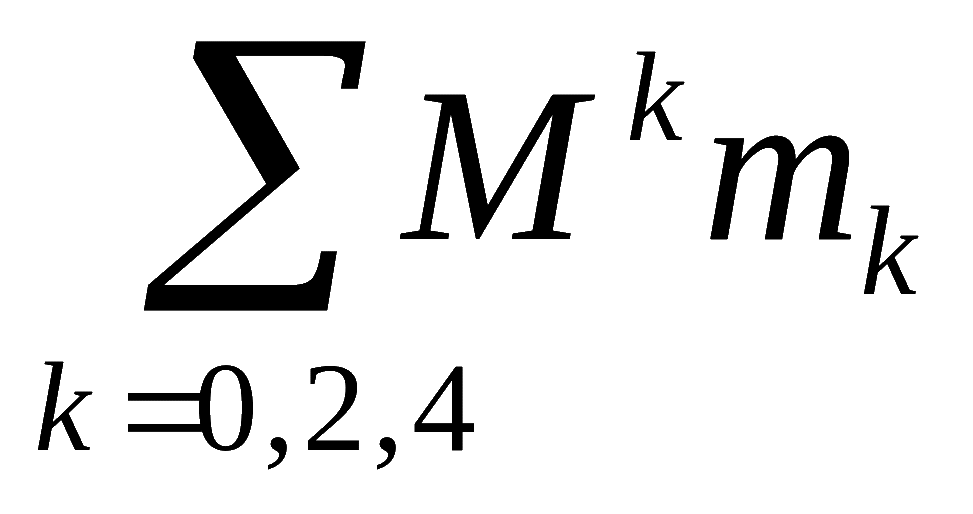
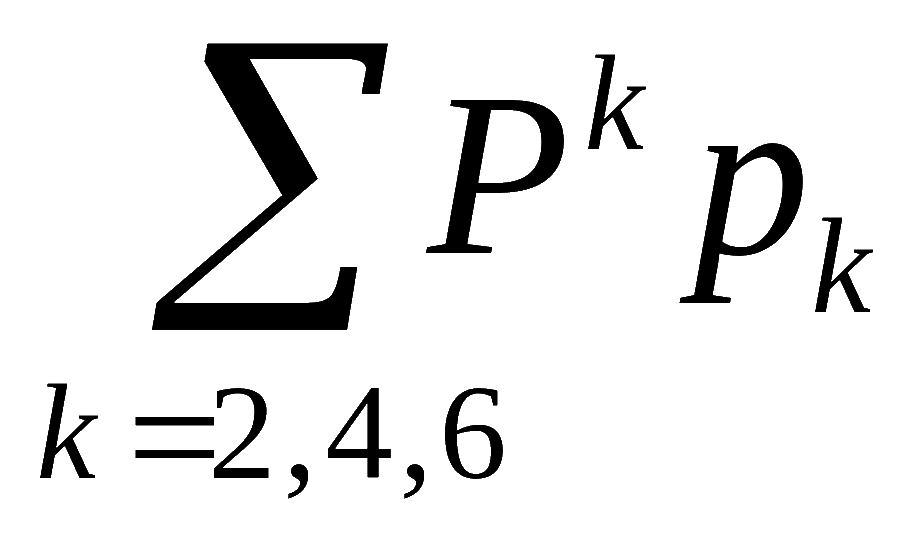
The Hamiltonian for the two-body configuration interactions H2 is parametrized by three parameters called α, β, γ in the first order refinement of the electron repulsion while that for the three-body configuration interactions H3 is parametrized by six parameters called Ts in the second order correction. The next two Hamiltonians represent the intra-atomic magnetic spin-spin HSS and spin-other orbit interactions HSOO between f-shell electrons, and the Hamiltonian for the electrostatically correlated spin-orbit interaction HEL-SO allows for the effect of configuration interactions upon the spin-orbit interaction. When fitting the atomic energy levels, many researchers usually express the Hamiltonian matrices for HSOO and HSS in terms of the Marvin integrals Mk and their associated operators mk , while the matrices for the HEL-SO Hamiltonian are given in terms of the Pk parameters and their associated operators pk. Hence,
|
HSS
+ HSOO =
| (3) |
H
EL-SO
= | (4) |
and

| (5) |
where k=2, 4, 6; s=2, 3, 4, 6, 7, 8; j=0, 2, 4 and i is the sum over all f-shell electrons. L is the total orbital angular momentum quantum number for the f-shell electrons while G(G2) and G(R7) are the eigenvalues of the Casimir operators of the groups G2 and R7, respectively. All the abovementioned parameters for HAT are collectively called free-ion parameters (FIPs).
When the f-shell ion is doped in a crystalline environment, it will experience a crystal field (or called ligand field) effect due to the short-range (e.g. overlapping and covalency), long-range (e.g. electrostatic point charge, dipolar and quadrupolar) and exchange (e.g. between ligands and between ligand and f-shell ion) interactions. For one-electron parametrization of crystal field with the complex crystal field parameters (CFPs) denoted by Bkq, the crystal field Hamiltonian HCF be written as
|
HCF=
| (6) |

where the rank k = 2, 4 and 6, the component q = -k, ...,k and Ckq are the normalised spherical harmonic tensor operators. There are up to 27 independent CFPs in case of C1 symmetry sites. Some components of CFPs are zero due to the site symmetry of f-shell ion and so there may be much fewer non-zero terms for Eq.(6), especially in high symmetry sites (e.g. just two independent CFPs for cubic symmetry sites). In C2 symmetry site, the explicit form of Eq.(6) becomes:
|
| (7) |
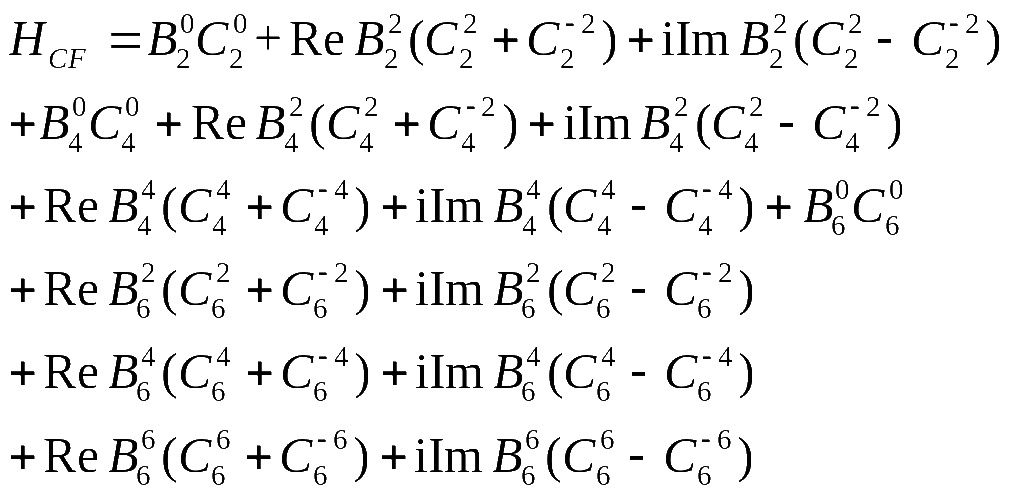
Note that we could rotate the coordinates frame about the z-axis in a certain orientation that the imaginary component of any CFP (e.g. B22) will become zero.
The complete Hamiltonian H for all the f-shell electrons of a lanthanide or actinide ion is simply
|
H = HAT + HCF | (8) |
To estimate the relative importance of different terms or interactions in the splittings of energy levels in the f-shell ion, we may assume that the open f-shell electrons are placed in a spherical potential which consists of Coulomb potential of nucleus and other closed shell electrons plus their kinetic energies. All of those contributions will collectively be represented by EAVE and so the model Hamiltonian can be rewritten as
|
H = EAVE + Hee + HSO + HCF | (9) |
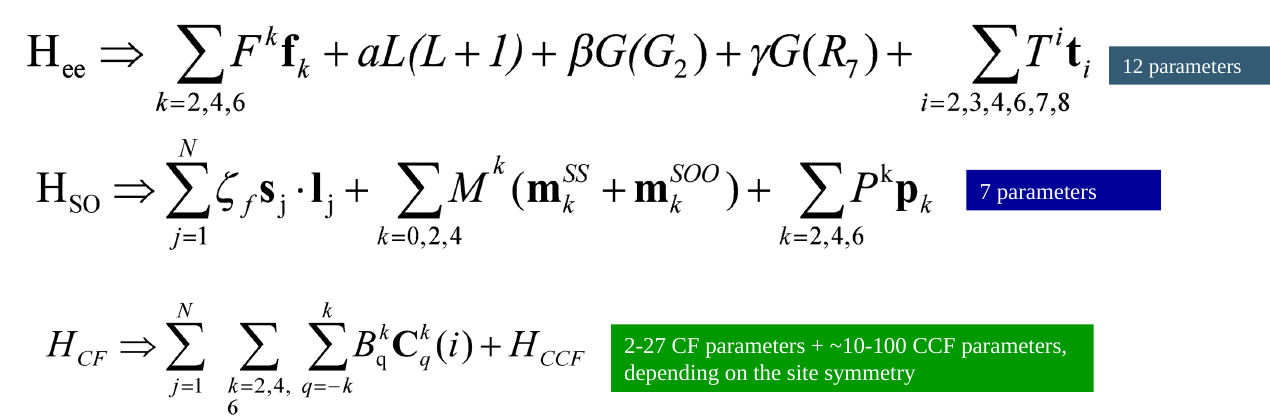
where Hee consists of the electrostatic repulsions between f-shell electrons, H2 and H3 Hamiltonians while HSO includes not only the spin-orbit interaction but also HSS, HSOO, and HEL-SO Hamiltonians. Parametrization of the revised model Hamiltonian in Eq.(9) (including configuration interactions and other intra-atomic magnetic effects as well as one-particle and two-particle/correlation crystal field) had been fruitfully done by G. Racah, B.R. Judd and B.G. Wybourne etc during 1940s to 1960s using the well-known Racah’s algebra, group theory, tensor operator techniques and angular momentum theory to separate each interaction into (a) radial integrals (for the magnitude of energy splittings which can be determined by fitting to observed spectra) and (b) angular parts (for the pattern of energy splittings which can be exactly calculated) (see Refs.[6-34] for details). The explicit form of the three Hamiltonians and their maximum number of parameters are given as follows:
Furthermore, the grouping and relative magnitude of splittings in the energy levels are depicted in the diagram (Figure 1) below:
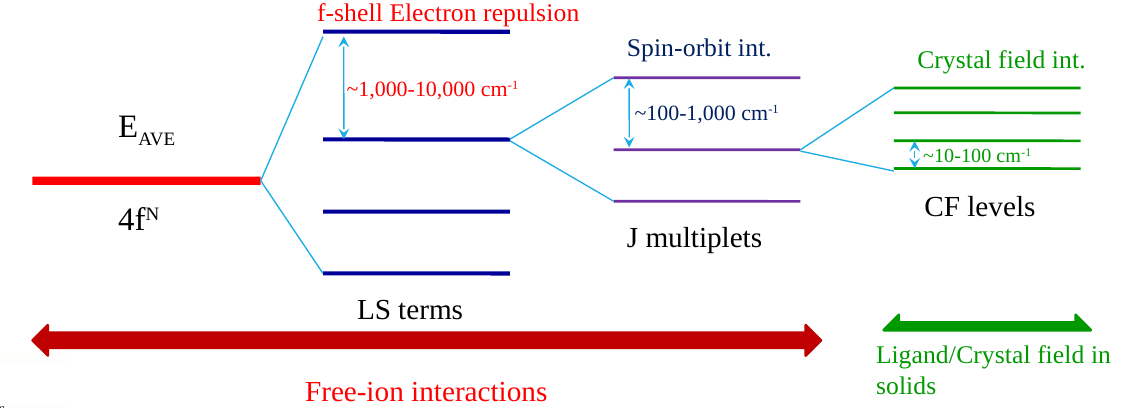
Figure 1: Schematic diagram for energy levels and their splittings of a f-shell ion into different clusters of LS terms and J multiplets and individual crystal field levels.
The interrelationship between the present paramatrization approach and the traditional experimental and ab initio calculations approaches is shown in Figure 2 below:
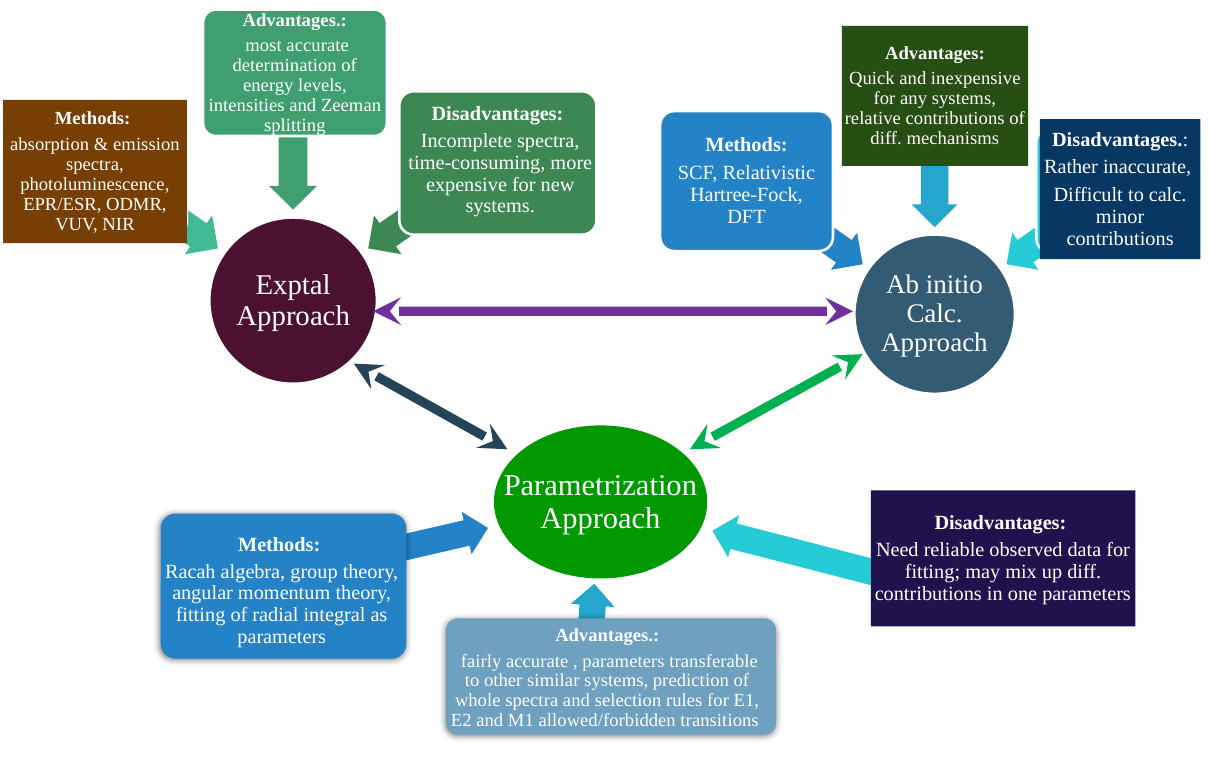
Figure 2: Framework for theoretical study of the optical/photophysical properties of f-shell ions
Features and functions of f-Spectra
Historically,
Hannah
Crosswhite and her co-workers in
the Argonne National Laboratory (Refs.[22, 23, 35]) had developed their own computer package to carry out numerous
fittings of free-ion and crystal field parameters to the observed energy levels of the lanthanide or actinide series during
1970s to 1980s.
However,
it is now verified from their fitted values of free-ion parameters
that the spin-spin component was absent from the fitting and
very high-lying states were truncated in
some
systems (e.g.
LaCl3:Ho3+
system) (see Refs.[34-35]),
probably because they
possessed the reduced
matrix elements (RME)
of the spin-spin operators only up to the f3
configuration and
had rather limited computer memory and computing time.
For
Crosswhite’s offspring fitting programs, i.e. M.F.
Reid’s
version and the SPECTRA program (see Refs.[24-25]), it
has also been
checked that both do not use the RME of the spin-spin operators up
to now even though they can do calculations for the complete Hamiltonian in full basis states.
Their operators mk
are
simply
set to be
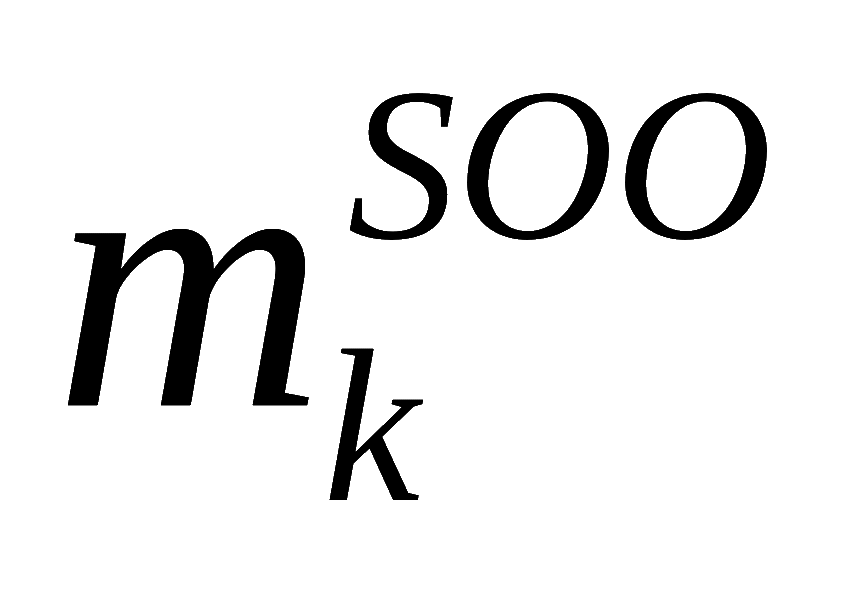 and their given reasons are that: (a) the effects of spin-spin interaction are rather small, and (b) those effects could be
effectively absorbed in the operators for the spin-other-orbit interaction. For another fitting program called ATOME as
independently developed by Denis Garcia and Michele Faucher (see Refs[36-37]) in the late 1980s, the spin-spin interaction Hamiltonian was absent right
from its earliest version despite of the subsequent addition of the
HSOO
and
HEL-SO
Hamiltonian in the early 2000s. This is a
rather
severe gap (see Ref.[34]) because the spin-spin interaction can lead to quite significant shifts in the calculated energy levels, e.g., by 20-30
cm-1
in 3P0,1
multiplets
of Cs2NaLnCl6:Tm3+,
up to around 10 cm-1
in various 4IJ
and 4GJ
multiplets of LaCl3:Nd3+
and around 25 cm-1
in the 5I4
multiplets of LaCl3:Ho3+.
Those shifts are comparable with the effects (around 10-30 cm-1)
of the correlation crystal field or the configuration-interaction assisted crystal field (i.e., configuration interaction of the
f-shell
with a charge transfer configuration) and so the inclusion of the spin-spin interaction Hamiltonian will likely cause a substantial
change in the fitted values of those parameters concerned.
and their given reasons are that: (a) the effects of spin-spin interaction are rather small, and (b) those effects could be
effectively absorbed in the operators for the spin-other-orbit interaction. For another fitting program called ATOME as
independently developed by Denis Garcia and Michele Faucher (see Refs[36-37]) in the late 1980s, the spin-spin interaction Hamiltonian was absent right
from its earliest version despite of the subsequent addition of the
HSOO
and
HEL-SO
Hamiltonian in the early 2000s. This is a
rather
severe gap (see Ref.[34]) because the spin-spin interaction can lead to quite significant shifts in the calculated energy levels, e.g., by 20-30
cm-1
in 3P0,1
multiplets
of Cs2NaLnCl6:Tm3+,
up to around 10 cm-1
in various 4IJ
and 4GJ
multiplets of LaCl3:Nd3+
and around 25 cm-1
in the 5I4
multiplets of LaCl3:Ho3+.
Those shifts are comparable with the effects (around 10-30 cm-1)
of the correlation crystal field or the configuration-interaction assisted crystal field (i.e., configuration interaction of the
f-shell
with a charge transfer configuration) and so the inclusion of the spin-spin interaction Hamiltonian will likely cause a substantial
change in the fitted values of those parameters concerned.
For the present f-Spectra computer package, it includes all the free-ion terms given in Eqs.(1-5) as well as one-electron (Eq.(6)) and two-electron crystal field Hamiltonian (as necessary). This package contains the following key features or capabilites which are different from or addtional to those of M.F. Reid and other similar packages:
- explicit and correct inclusion of the spin-spin interaction;
- automatic labelling of irreducible representations for crystal field levels;
- free of the mistakes in those data files for the reduced matrix elements of f-shell configurations as identified in the literature;
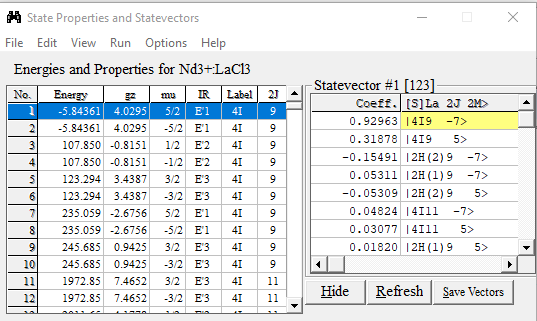
- calculations of all energy levels and statevectors for free-ion spectra and crystal field spectra in arbitrary symmetry sites;
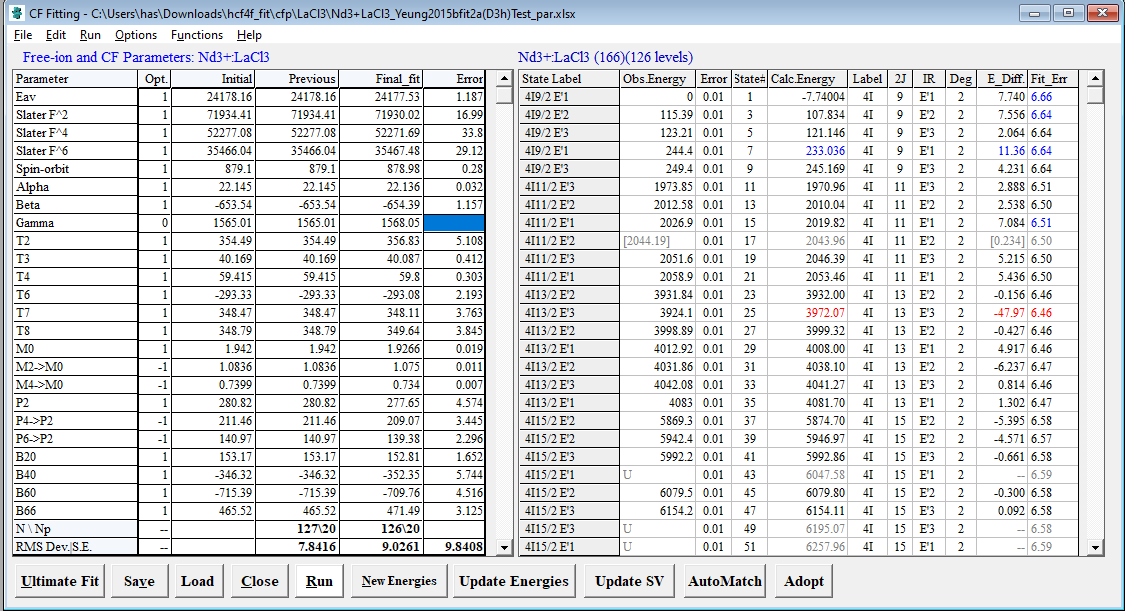
- fittings of energy levels to FIPs and/or one-electron and certain two-electron CFPs for free-ion spectra and crystal field spectra in arbitrary symmetry sites;
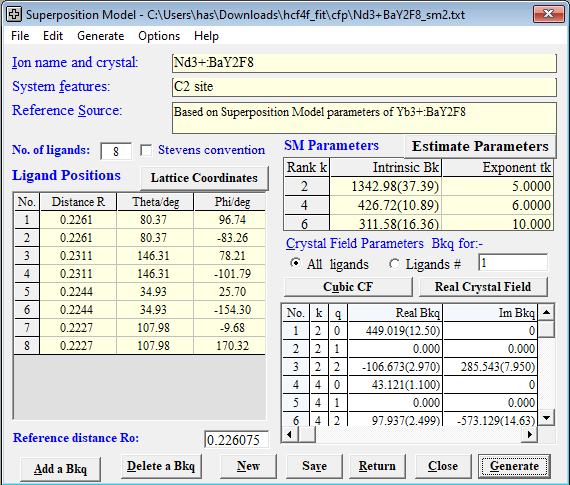
- predictions of CFPs using the Superposition Model;
- fittings of energy levels to FIPs and Superposition Model parameters for crystal field spectra in arbitrary symmetry sites;
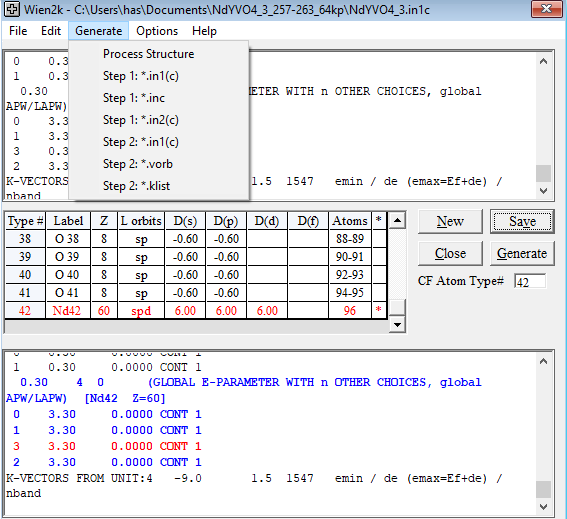
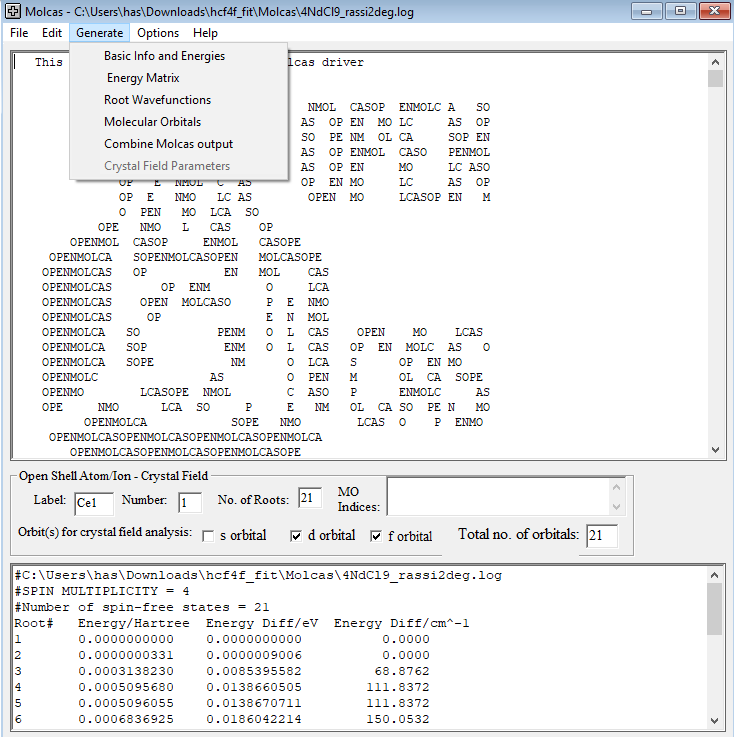
- facilitating the first-principles calculations of CFPs using the [Open] Molcas or Wien2k computer packages;
- calculations and fittings of magnetic Zeeman and zero-field splittings (i.e. g-factors) for ground and any excited states;
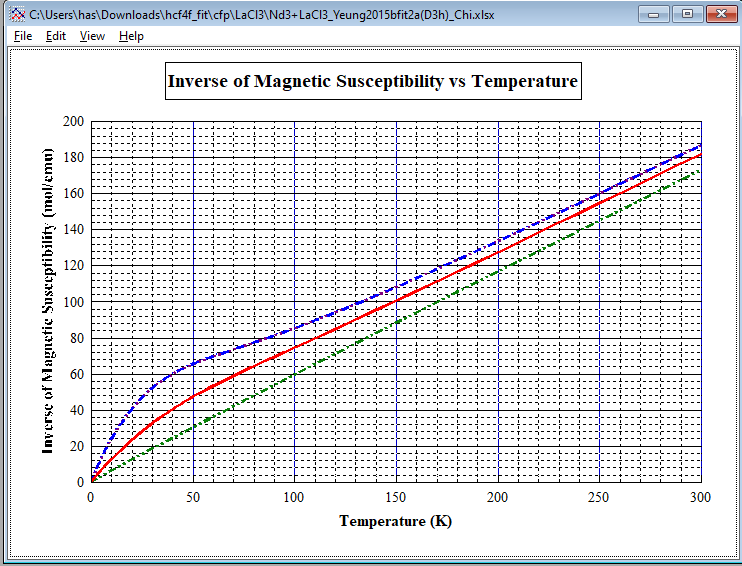
- calculations of anisotropic magnetic susceptibility for different temperature;
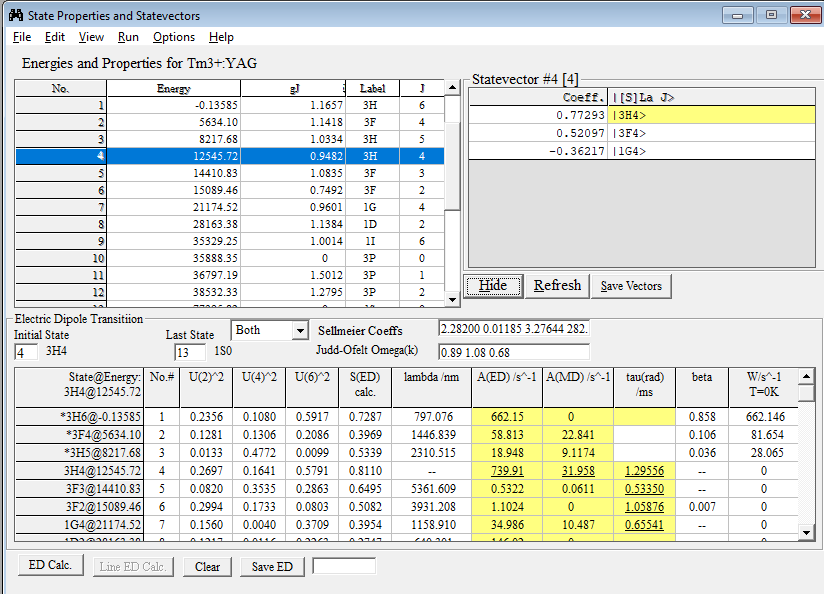
- calculations of magnetic dipole, electric dipole and electric quadrupole transition properties (e.g. oscillator strengths and transition rates) between all levels using the complete set of eigenvectors;
- fitting of Judd-Ofelt intensity parameters to the observed intensities for the spin-forbidden intra f-shell transitions;
- error estimation for the fitted values of FIPs and CFPs; and
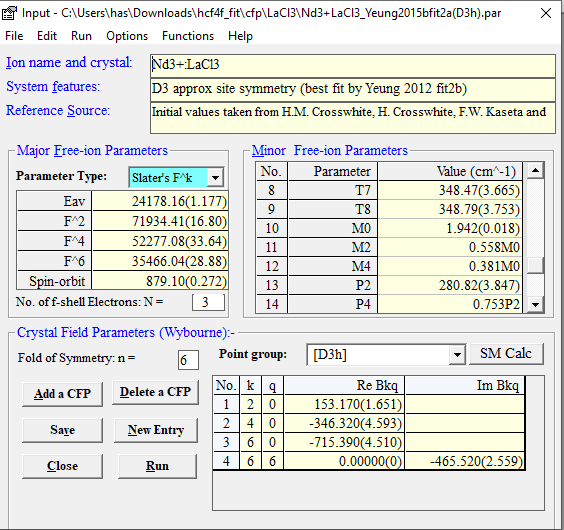
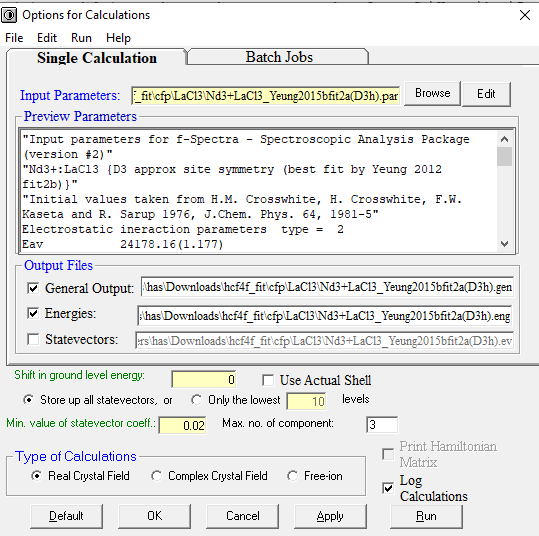
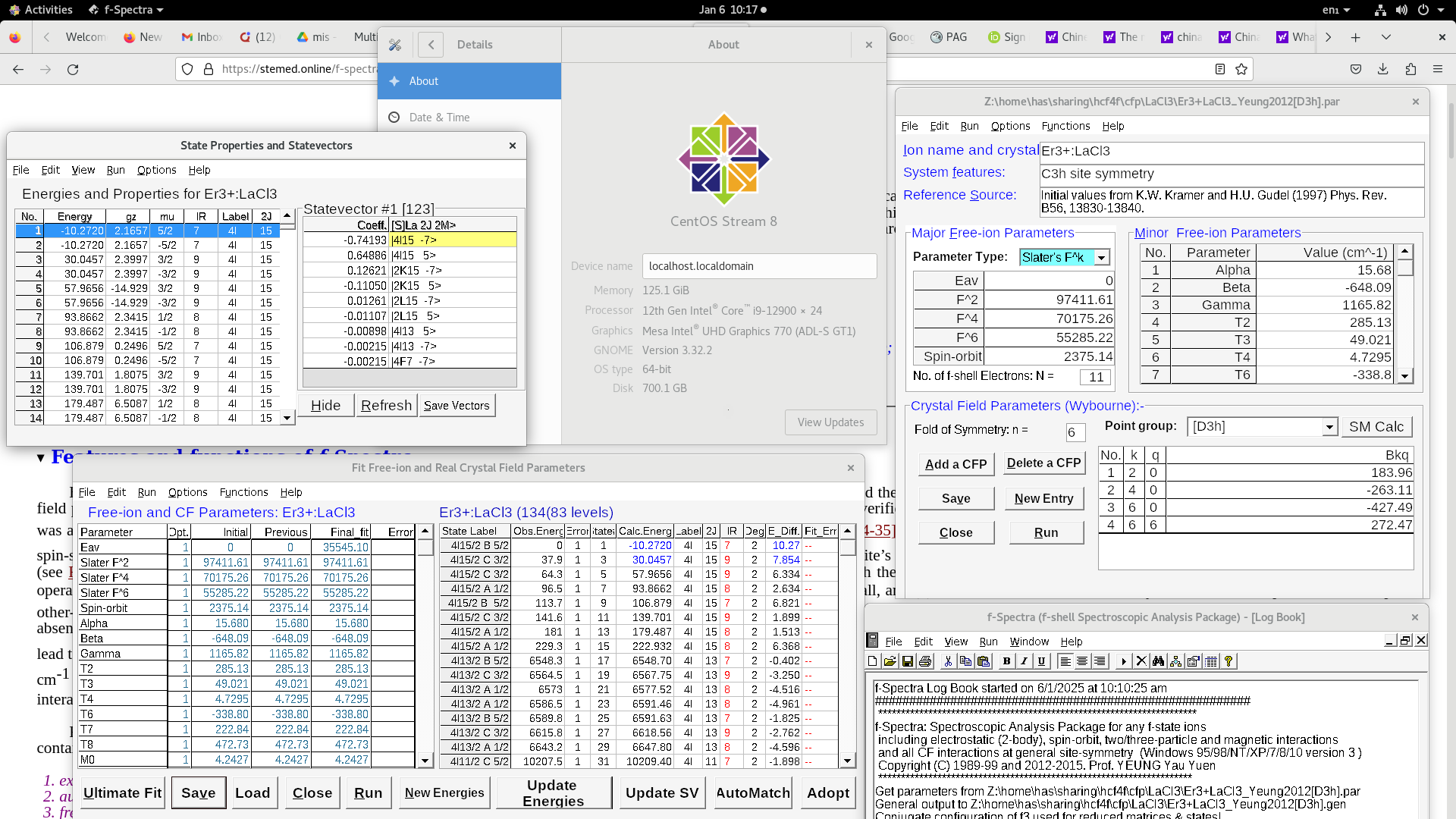
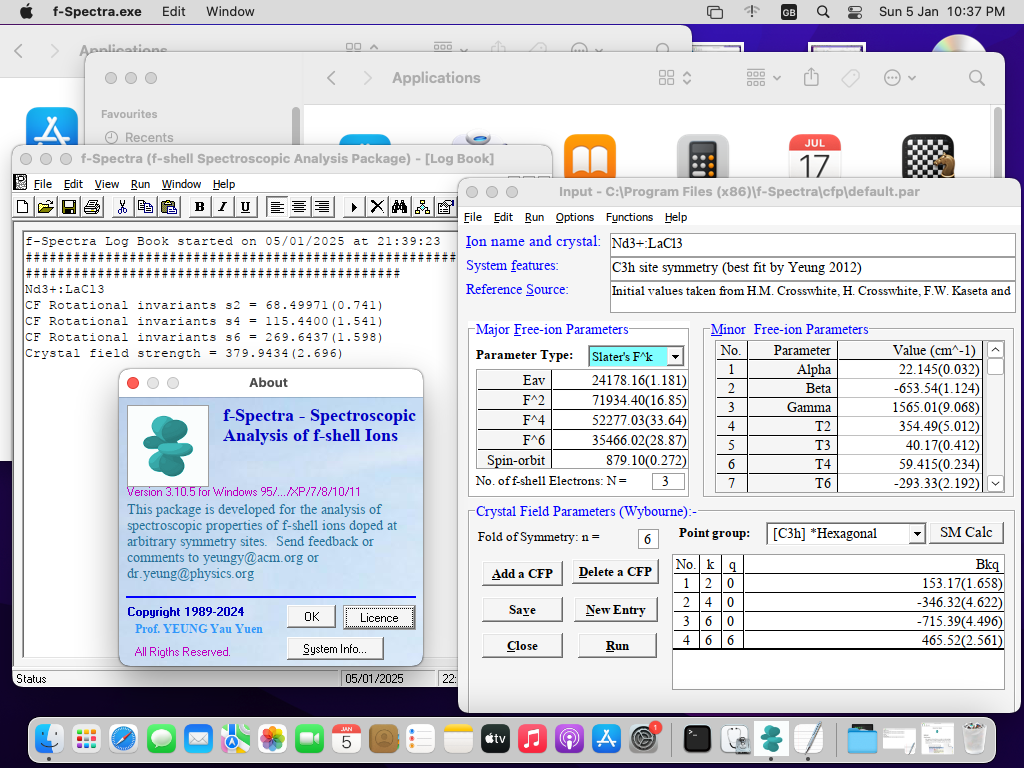
- user-friendly graphical interface incorporated for easy and rapid manipulation of input data, settings of fitting parameters and organization of calculated results in the Microsoft Windows environment. This package can be run in the Linux environment using the Wine program. There is also an application program made available for MacOS machines by embedding it with the Wine program in a container.
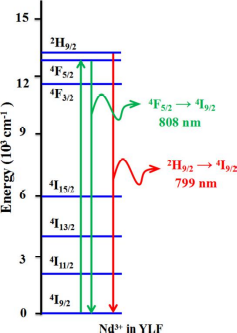
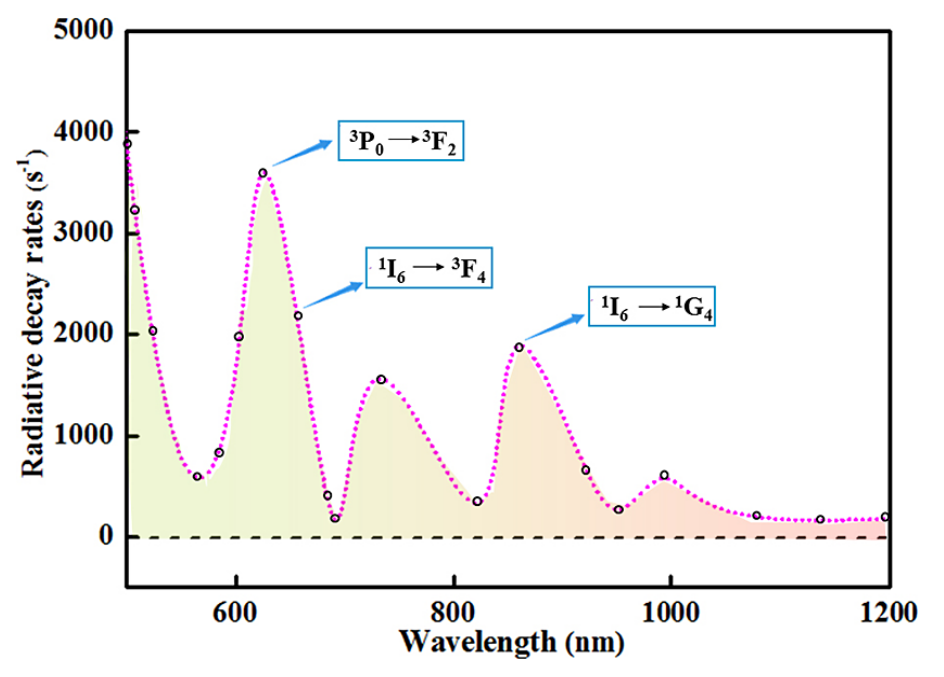
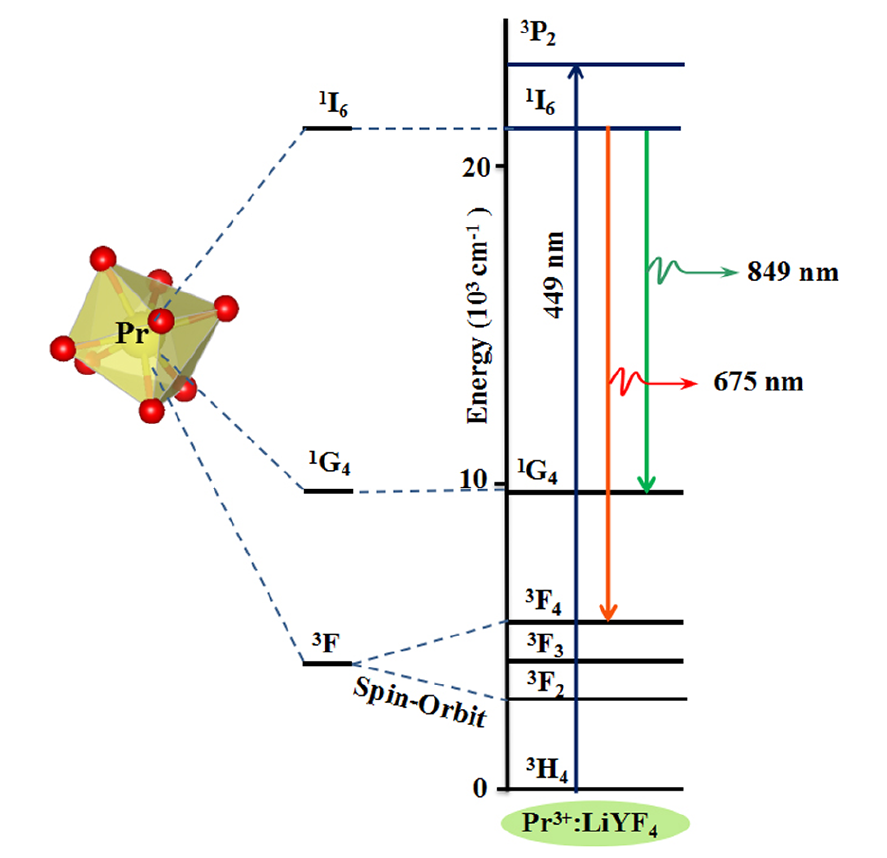
Some sample results are shown in the Figures 3 and 4 below.
 |
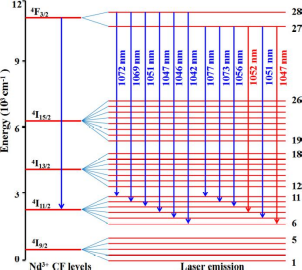 |
(a) The calculated electric dipole (ED) transitions that produce emission wavelengths at 799 and 808 nm are shown. |
(b) The calculated magnetic dipole (MD) emission lines for transitions from the emitting 4F3/2 levels to the Stark levels of the 4I11/2 manifold. |
Figure 3: Diagrams for the energy levels and selected ED and MD transitions for neodymium ion (Nd3+) doped yttrium lithium fluoride (LiYF4, YLF) laser crystals. (Adopted from Ref.[38])
 |
 |
(a) Simulated emission spectrum from 500 to 1200 nm corresponding to the radiative decay rates.
|
(b) Energy transfer mechanism diagram and the possible transitions at 675 and 849 nm.
|
Figure 4: Diagrams for the emission spectrum and energy transfer mechanism of the Pr3+ ion doped in LiYF4. (Adopted from Ref.[39])
Furthermore, this package is embedded with various minor but useful functions which are required to
- convert FIPs and CFPs between different conventions;
- convert values of various parameters between different units used;
- convert CFPs between different coordinates frame or rotation of axes;
- convert magnetic parameters between different conventions;
- calculate various angular momentum coupling coefficients like 3j, 6j and 9j symbols;
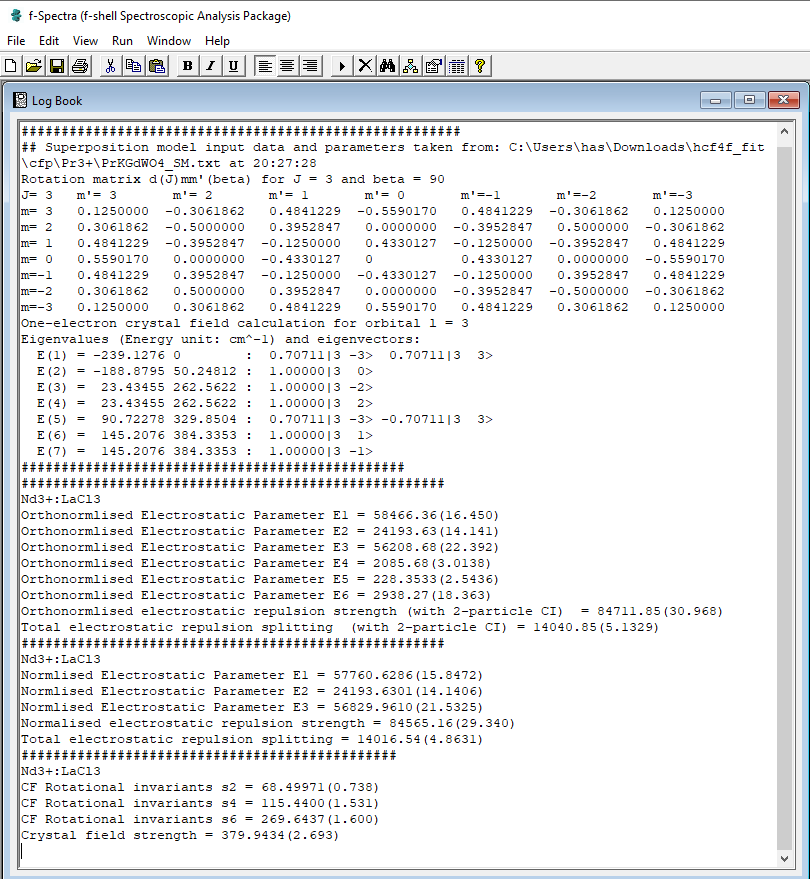
- calculate the rotation matrix for any angular momentum quantum number and any angles;
- calculate reduced matrix elements of any tensor operators relevant to the spectroscopic analysis of any f-shell configuration;
- calculate crystal field rotational invariants and strength;
- calculate orthonormalised electrostatic parameters and electrostatic repulsion strength;
- calculate pure crystal field splittings for a single f-shell electron;
- find the approximate cubic CFPs for CFPs of low-symmetry site;
- find the ligand positions in polar coordinates for Superposition Model analysis; and
- record the results of the above-mentioned calculations and key information on the processes of fitting in a logbook.
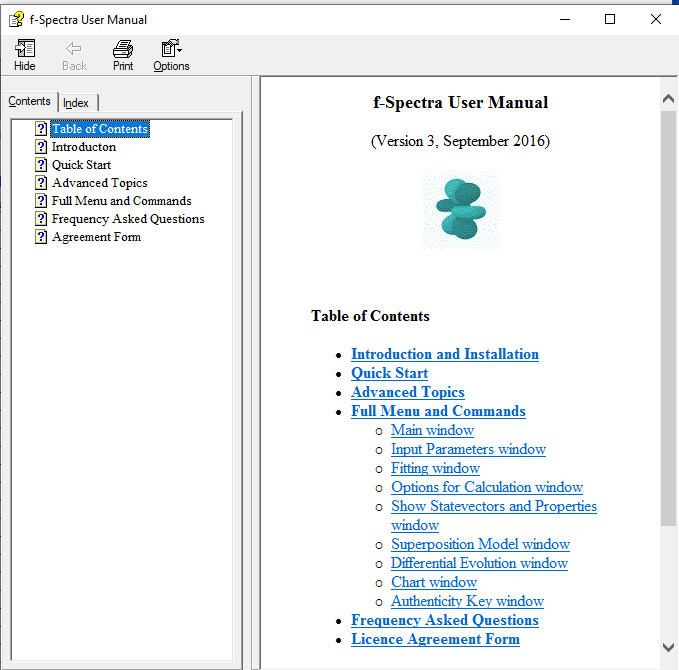
Screen shots of f-Spectra
References
- S. Hufner, Optical Spectra of Transparent Rare Earth Compounds, Academic Press, New York, 1978.
- B.G. Wybourne, Spectroscopic Properties of Rare Earths, Interscience, New York, 1965.
- B.R. Judd, Atomic theory and optical spectroscopy, in: K.A. Gschneidner, Jr., L. Eyring (Eds.), Handbook on the Physics and Chemistry of Rare Earths, Vol. 11, Elsevier, Amsterdam, 1988, pp.81-195.
- Y.Y. Yeung, D.J. Newman, J. Phys. C: Solid St. Phys. 19 (1986) 3877-3884.
- Y.Y. Yeung, D.J. Newman, J. Chem. Phys. 86 (1987) 6717-6721.
- G. Racah, Phys. Rev. 51 (1942) 186-197.
- G. Racah, Phys. Rev. 62 (1942) 438-462.
- G. Racah, Phys. Rev. 63 (1943) 367-382.
- G. Racah, Phys. Rev. 76 (1949) 1352-1365.
- B.R. Judd, Phys. Rev. 141 (1966) 4-14.
- B.R. Judd, H.T. Wadzinski, J. Math. Phys. 8 (1967) 2125-2130.
- B.R. Judd, H.M. Crosswhite, H. Crosswhite, Phys. Rev. 169 (1968) 130-138.
- H. Crosswhite, H.M. Crosswhite, B.R. Judd, Phys. Rev. 174 (1968) 89-94.
- H. Crosswhite, B.R. Judd, At. Data 1 (1970) 329-357.
- B.R Judd, H. Crosswhite, J. Opt. Soc. Am. B1 (1984) 255-260.
- B.R Judd, M.A. Suskin, J. Opt. Soc. Am. B1 (1984) 261-265.
- B.R. Judd, GMS Lister, J. Phys. B: At. Mol. Phys. 26 (1993) 3177-3188.
- B.R. Judd, E. Lo, J. Phys.: Condens. Matter 6 (1994) L799-L801.
- J.E. Hansen, B.R. Judd, H. Crosswhite, At. Data Nucl. Data Tables 62 (1996) 1-49.
- E. Lo, J.E. Hansen, B.R. Judd, J. Phys. B: At. Mol. Phys. 33 (2000) L819-L822.
- B.R. Judd, J.E. Hansen, Mol. Phys. 102 (2004) 1207-1211.
- H.M. Crosswhite, Systematic atomic and crystal-field parameters for lanthanides in LaCl3 and LaF3, in: Spectroscopie des Elements de Transition et des Elements Lourdes dans Les Solides, Editions du CNRS, Paris, 1977, pp. 65-69.
- H.M. Crosswhite, H. Crosswhite, J. Opt. Soc. Am. B1 (1984) 246-254.
- G. K. Liu, W. T. Carnall, G. Jursich,, C. W. Williams, J. Chem. Phys. 101 (1994) 8277-8289.
- X.Y. Chen, G.K. Liu, J. Margerie, M. F. Reid, J. Lumin. 128 (2008) 421-427.
- B.R. Judd, Physica 33 (1967) 174-182.
- A. Pasternak, Z. B. Goldschmidt, Phys. Rev. A6 (1972) 55-68.
- B.R. Judd, J.E. Hansen, A.J.J. Raassen, J. Phys. B15 (1982) 1457-1472.
- J.E. Hansen, B.R. Judd, J. Phys. B: At. Mol. Phys. 18 (1985) 2327-2338.
- R. Glass, Z. Physik A292 (1979) 131-134.
- H. Horie, Prog. Theor. Phys. 10 (1953) 296-308.
- C.W. Nielson, G.F. Koster, Spectroscopic Coefficients for the pn, dn and fn Configurations, MIT Press, Cambridge, MA, 1963.
- B.R. Judd, Operator Techniques in Atomic Spectroscopy, McGraw-Hill, New York, 1963.
- Y.Y. Yeung, Atomic Data and Nuclear Data Tables, 100 (2014) 536–576.
- H.M. Crosswhite, H. Crosswhite, F.W. Kaseta, R. Sarup, J. Chem. Phys. 64 (1976) 1981-1985.
- D. Garcia, M. Faucher, J. Chem. Phys. 90 (1989) 5280-5283.
- D. Garcia, M. Faucher, J. Chem. Phys. 91 (1989) 7461-7466.
- Y. Xiao, X. Kuang, Y.Y. Yeung, & M. Ju, Physical Chemistry Chemical Physics, 22(2020), 21074-21082. https://doi.org/10.1039/D0CP03748F
- Y. Xiao, Q. Luo, M. Ju, & Y.Y.Yeung, The Journal of Physical Chemistry A, 128, 42(2024), 9107–9113. https://doi.org/10.1021/acs.jpca.4c03698
Publications rendered by f-Spectra
Licenses and Sponsorship of f-Spectra